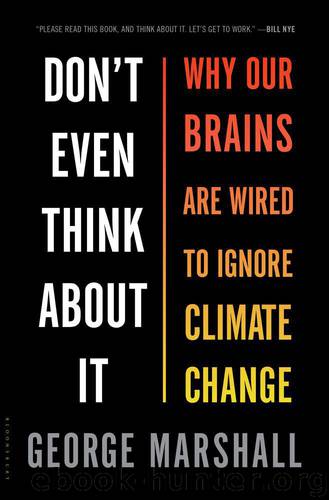
Don't Even Think About It: Why Our Brains Are Wired to Ignore Climate Change by George Marshall
Author:George Marshall [Marshall, George]
Language: eng
Format: mobi
Publisher: Bloomsbury Publishing
Published: 2014-08-18T14:00:00+00:00
25
Polarization
Why Polar Bears Make It Harder to Accept Climate Change
It’s a gray autumn Sunday afternoon and I am following Aurora, a giant animatronic polar bear, the size of a double-decker bus, as she stalks the streets of London, pacing, sniffing, roaring. Around her neck are strips of cloth bearing the names of three million supporters. She is preceded by three ice spirits with glitter and wands doing some kind of free-form dance. All around me are people in white face paint with blackened noses, woolly white hats, and stick-on ears.
Now, I know that this is a Greenpeace protest against drilling in the Arctic, but without my codebook, a forty-foot-long icon bearing three million blessings being pushed by two thousand people looks more like the annual procession of the Hindu chariot of Lord Jagannath—known to the world as the Juggernaut. I wonder if we should throw ourselves under its paws.
Of course this is not a religion and it would be silly to say it was. But nor it is a carnival or a big press stunt either. It is revealing that when I invite the people in the march to tell me about the puppet, they don’t talk about it at all—they immediately start talking about their concerns about polar bears, the climate, and the future. To them Aurora is a powerful representational symbol onto which they can project their collective values and concerns.
Polar bears are the ubiquitous symbol of climate change. The magazine cover, B-roll footage, stick-it-in stock photo agency picture for any climate change story. When Time magazine ran its first special issue on climate change, its cover headline, “Be Worried. Be Very Worried,” accompanied a photograph of a lonely polar bear perched on a tiny iceberg looking at us with anxiety, hunger, desperation . . . well, with whatever expression we wish to project onto it.
As a result, people in focus groups choose the polar bear as the number-one icon of climate change, saying that they are drawn to it because it represents “the idea of a pure fragile environment most affected by change.”
No environmentalist I spoke to could ever recall a formal decision in their organization to select a polar bear as a campaign icon. The National Wildlife Federation justifies the emphasis on polar bears because they are “the proverbial canary in the coal mine” but this is a weak (and zoologically confused) metaphor. The long-term future is not looking good for polar bears but there are very large variations in predictions for them in the short term, with some populations (especially around Hudson Bay in Canada) declining and others rising following the suspension of hunting.
The real reasons that polar bears became an icon are that climate change initially focused on the Arctic and that environmental organizations have always used iconic megafauna to symbolize complex resource issues. No other progressive campaign constituency would have chosen this emblem—there are no bears of any kind in the materials of human rights, refugee, health charities, trade unions, business organizations, or faith groups.
Download
This site does not store any files on its server. We only index and link to content provided by other sites. Please contact the content providers to delete copyright contents if any and email us, we'll remove relevant links or contents immediately.
Man-made Catastrophes and Risk Information Concealment by Dmitry Chernov & Didier Sornette(6139)
The Revenge of Geography: What the Map Tells Us About Coming Conflicts and the Battle Against Fate by Kaplan Robert D(4104)
Zero Waste Home by Bea Johnson(3884)
COSMOS by Carl Sagan(3670)
Good by S. Walden(3603)
In a Sunburned Country by Bill Bryson(3583)
The Fate of Rome: Climate, Disease, and the End of an Empire (The Princeton History of the Ancient World) by Kyle Harper(3090)
A Wilder Time by William E. Glassley(2895)
Camino Island by John Grisham(2824)
Organic Mushroom Farming and Mycoremediation by Tradd Cotter(2720)
The Ogre by Doug Scott(2715)
Energy Myths and Realities by Vaclav Smil(2531)
Human Dynamics Research in Smart and Connected Communities by Shih-Lung Shaw & Daniel Sui(2519)
The Traveler's Gift by Andy Andrews(2491)
9781803241661-PYTHON FOR ARCGIS PRO by Unknown(2403)
Inside the Middle East by Avi Melamed(2389)
Birds of New Guinea by Pratt Thane K.; Beehler Bruce M.; Anderton John C(2277)
A History of Warfare by John Keegan(2267)
And the Band Played On by Randy Shilts(2243)
